 Ricky J. Sethi
About...
Ricky J. Sethi is currently a Professor of Computer Science at Fitchburg State University. Ricky is also Director of Research for the Madsci Network and an Adjunct Professor at Worcester Polytechnic Institute (WPI).
Prior to FSU, he was a Research Scientist at UMass Amherst/UMass Medical School and at UCLA/USC Information Sciences Institute, where he was chosen as an NSF Computing Innovation Fellow (CIFellow) by the CCC and the CRA. Before that, he was a Post-Doctoral Scholar at UCR, where he was the Lead Integration Scientist for the WASA project and participated in ONR's Empire Challenge 10.
Ricky has authored or co-authored over 30 peer-reviewed papers, book chapters, and reports and made numerous presentations on his research in machine learning, computer vision, social computing, and data science. He has taught various courses in Computer Science and Physics and has also supervised/mentored undergraduate students, graduate students, and postdoctoral students at UCLA, USC, and UMass.
Ricky has served as a Panelist for several NSF programs, as an Associate Editor for Frontiers in Artificial Intelligence, as an Editorial Board Member for the International Journal of Computer Vision & Signal Processing, and a Program Committee member for various conferences. In addition, he is a member of the YSP/Madsci Financial Board, a member of the American Institute of Physics, and a member of IEEE.
Education
Ricky received his B.A. in Molecular and Cellular Biology (Neurobiology) and Physics from the University of California, Berkeley, his M.S. in Physics/Business (Information Systems) from the University of Southern California, and his Ph.D. in Computer Science (Artificial Intelligence) from the University of California, Riverside.
External Academic Profiles
- Google Scholar Profile: scholar.google.com/citations?user=TwvsWQQAAAAJ
- ResearchGate Profile: www.researchgate.net/profile/Ricky_Sethi/
- OrcID: orcid.org/0000-0001-5254-3750
Media Mentions
- AI and You podcast: Part 1 and Part 2
- Newsy interview on "The Why" about AI: YouTube interview
- TechXplore article about Artificial Metacognition research: article
- Live Science article about Artificial Metacognition research: article
- Chicago Tribune article about Fake News/Fact-Checking research: article
- Huffington Post article about Scientific Workflows for Visual Stylometry: article
- Communications of the ACM on Computers to Understand Art: article
- Sentinel & Enterprise - WAIVS/FAM: article
- Sentinel & Enterprise - NEH Grant: article
- Telegram & Gazette - NEH: article
- The Conversation article about Artistic Style in Art research: article
- The Conversation article about Crowdsourced Fact-Checking research: article
- The Conversation article about Artificial Metacognition research: article
Book
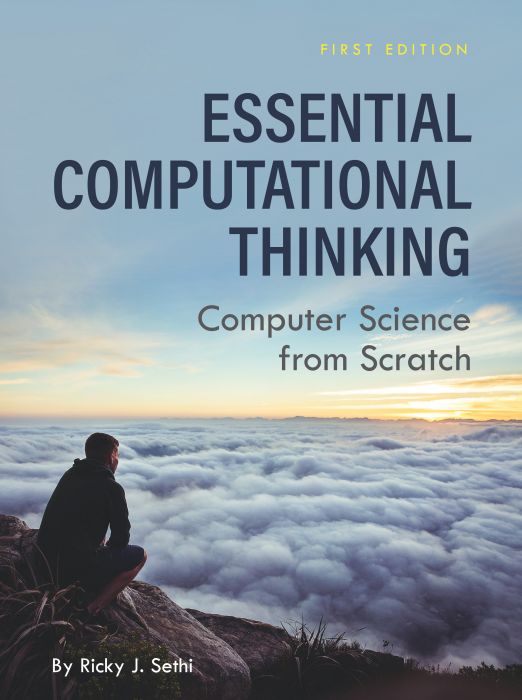
Essential Computational Thinking
Computer Science from Scratch
by Ricky J. Sethi © 2020
Selected Publications, Awards, and Grants
Refereed Conferences and Workshops
- Charles Courchaine*, Ricky J. Sethi*, and Hefei Qiu,
"Implementation of a Metacognition Framework for Self-Awareness and Self-Regulation in Ensembles of LLMs".
ACM Proceedings of The Web Conference (TheWebConf) (2026).

- Ricky J. Sethi, Hefei Qiu, Charles Courchaine, and Joshua Iacoboni,
"Do LLMs Dream of Electric Emotions? Towards Quantifying Metacognition and Generalizing the Teacher-Student Model Using Ensembles of LLMs".
ACM International Conference on Information and Knowledge Management (CIKM) (2025).
- Charles Courchaine, Corey Wade, Tasnova Tabassum, Stetson Daisy, and Ricky J. Sethi,
"Towards Explainable Total Recall in TAR for eDiscovery Using Retraining of the Underlying Neural Network Model".
Proceedings of ALTARS in ACM European Conference on Information Retrieval (ECIR) (2024).
- Charles Courchaine, Tasnova Tabassum, Corey Wade, and Ricky J. Sethi,
"Explainable e-Discovery (XeD) Using an Interpretable Fuzzy ARTMAP Neural Network for Technology-Assisted Review".
Proceedings of LegalIR in IEEE International Conference on Big Data (BIG DATA) (2023).
- Charles Courchaine and Ricky J. Sethi,
"Opening the TAR Black Box: Developing an Interpretable System for eDiscovery Using the Fuzzy ARTMAP Neural Network".
Proceedings of LegalIR in ACM European Conference on Information Retrieval (ECIR) (2023).
- Charles Courchaine and Ricky J. Sethi,
"Fuzzy Law: Towards Creating a Novel Explainable Technology-Assisted Review System for e-Discovery".
IEEE International Conference on Big Data (BIG DATA) (2022).
- Ricky J. Sethi, Raghuram Rangaraju, and Bryce Shurts,
"Fact Checking Misinformation Using Recommendations from Emotional Pedagogical Agents".
15th International Conference on Intelligent Tutoring Systems (ITS) (2019).
- Ricky J. Sethi and Raghuram Rangaraju,
"Extinguishing the Backfire Effect: Using Emotions in Online Social Collaborative Argumentation for Fact Checking".
IEEE International Conference on Web Services (IEEE ICWS) (2018).
- Ricky J. Sethi, Catherine A. Buell, William P. Seeley, and Swaroop Krothapalli,
"An Open Access Platform for Analyzing Artistic Style Using Semantic Workflows".
IEEE International Conference on Web Services (IEEE ICWS) (2018).
- Ricky J. Sethi, Catherine A. Buell, and William P. Seeley,
"WAIVS: An Intelligent Interface for Visual Stylometry Using Semantic Workflows".
ACM International Conference on Intelligent User Interfaces (ACM IUI) (2018).
- Ricky J. Sethi,
"Spotting Fake News: A Social Argumentation Framework for Scrutinizing Alternative Facts".
IEEE International Conference on Web Services (IEEE ICWS) (2017).

- Catherine A. Buell, William P. Seeley, and Ricky J. Sethi,
"A Framework for Computing Artistic Style Using Artistically Relevant Features".
IEEE International Conference on eScience (IEEE eScience) (2017).
- Ricky J. Sethi,
"Crowdsourcing the Verification of Fake News and Alternative Facts".
ACM Conference on Hypertext and Social Media (ACM HT) (2017). (Demo)
- Ricky J. Sethi,
"Fact-Checking via Structured Discussions in Virtual Communities".
3rd Workshop on Social Media World Sensors (Sideways) at ACM Conference on Hypertext and Social Media (ACM HT) (2017). (Keynote)
- Ricky J. Sethi and Yolanda Gil,
"Reproducibility in computer vision: Towards open publication of image analysis experiments as semantic workflows".
IEEE International Conference on eScience (IEEE eScience) (2016). (Oral)
- Kabir Chug and Ricky J. Sethi,
"Collaboration in Computer Vision using Scientific Workflows".
IEEE International Conference on Collaboration Technologies and Systems (IEEE CTS) (2016).
- Ricky J. Sethi,
"Towards Defining Groups and Crowds in Video Using the Atomic Group Actions Dataset".
IEEE International Conference on Image Processing (IEEE ICIP) (2015). (Oral)
- Ricky J. Sethi,
"A Perceptually-Inspired Stochastic Framework for Video Search and Analysis".
Perception Inspired Video Processing held in conjunction with ACM International Conference on Multimedia (ACM MM) (2014). (Oral)
- Ricky J. Sethi, Yolanda Gil, Hyunjoon Jo, and Andrew Philpot,
"Large-Scale Multimedia Content Analysis Using Scientific Workflows".
ACM International Conference on Multimedia (ACM MM) (2013). (Oral)
- Yolanda Gil, Angela Knight, Kevin Zhang, Larry Zhang, and Ricky J. Sethi,
"An Initial Analysis of Semantic Wikis".
ACM International Conference on Intelligent User Interfaces (ACM IUI) (2013). - Ricky J. Sethi, Hyunjoon Jo, and Amit K. Roy-Chowdhury,
"A Generalized Data-Driven Hamiltonian Monte Carlo for Hierarchical Activity Search".
IEEE International Conference on Image Processing (IEEE ICIP) (2013).
- Ricky J. Sethi and Lynn Bry,
"The Madsci Network: Direct Communication of Science from Scientist to Layperson".
21st International Conference on Computers in Education (APSCE ICCE) (2013).
- Ricky J. Sethi, Hyunjoon Jo, and Yolanda Gil,
"Re-Using Workflow Fragments Across Multiple Data Domains".
Proceedings of the Seventh Workshop on Workflows in Support of Large-Scale Science held in conjunction with ACM/IEEE Supercomputing Conference (ACM/IEEE SC) (2012). (Oral)
- Ricky J. Sethi, Lorenzo A. Rossi, and Yolanda Gil,
"Measures of Threaded Discussion Properties".
Intelligent Support for Learning in Groups at International Conference on Intelligent Tutoring Systems (ITS) (2012).
- Ricky J. Sethi and Amit K. Roy-Chowdhury,
"A Physics-based Stochastic Framework for Activity Recognition and Analysis".
51st Conference of the Society of Instrument and Control Engineers (SICE) (2011). (Oral)
- Matheus Hauder, Yolanda Gil, Ricky J. Sethi, Yan Liu, and Hyunjoon Jo,
"Making Data Analysis Expertise Broadly Accessible through Workflows".
Proceedings of the Sixth Workshop on Workflows in Support of Large-Scale Science held in conjunction with ACM/IEEE Supercomputing Conference (ACM/IEEE SC) (2011). (Oral)
- Ricky J. Sethi and Amit K. Roy-Chowdhury,
"Modeling and Recognition of Complex Multi-Person Interactions in Video".
ACM Workshop on Multimodal Pervasive Video Analysis held in conjunction with ACM Multimedia (ACM MM) (2010). (Oral)
- Ricky J. Sethi and Amit K. Roy-Chowdhury,
"The Human Action Image".
19th International Conference on Pattern Recognition (IAPR ICPR) (2010).
- Ricky J. Sethi and Amit K. Roy-Chowdhury,
"A Neurobiologically Motivated Stochastic Method for Analysis of Human Activities in Video".
19th International Conference on Pattern Recognition (IAPR ICPR) (2010).
- Ricky J. Sethi, Amit K. Roy-Chowdhury, and Saad Ali,
"Activity Recognition by Integrating the Physics of Motion with a Neuromorphic Model of Perception".
IEEE Workshop on Motion and Video Computing (IEEE WMVC)/IEEE Workshop on Applications of Computer Vision (IEEE WACV) (2009).
Book Chapters
- Nandita M. Nayak *, Ricky J. Sethi *, Bi Song, and Amit K. Roy-Chowdhury,
"Modeling and Recognition of Complex Human Activities".
In T. B. Moeslund, L. Sigal, V. Kruger, and A. Hilton (Eds.), Visual Analysis of Humans. Springer-Verlag (2011).
- Bi Song, Ricky J. Sethi, and Amit K. Roy-Chowdhury,
"Wide Area Tracking in Single and Multiple Views".
In T. B. Moeslund, L. Sigal, V. Kruger, and A. Hilton (Eds.), Visual Analysis of Humans. Springer-Verlag (2011).
- Ricky J. Sethi, Amit K. Roy-Chowdhury, and Ashok Veeraraghavan,
"Gait Recognition Using Motion Physics in a Neuromorphic Computing Framework".
In B. Bhanu and V. Govindaraju (Eds.), Multibiometrics for Human Identification. Cambridge University Press (2010).
Journals
- Catherine A. Buell, Yolanda Gil, William P. Seeley, and Ricky J. Sethi,
"Intelligent Workflows for Visual Stylometry".
ACM Special Interest Group on Artificial Intelligence (ACM SIGAI) (2018).
- Ricky J. Sethi and Yolanda Gil,
"Scientific Workflows in Data Analysis: Bridging Expertise Across Multiple Domains".
Future Generation Computer Systems (FGCS) (2017).
- Richard De Veaux, Mahesh Agarwal, Maia Averett, Benjamin Baumer, Andrew Bray, Thomas Bressoud, Lance Bryant, Lei Cheng, Amanda Francis, Robert Gould, Albert Y. Kim, Matt Kretchmar, Qin Lu, Ann Moskol, Deborah Nolan, Roberto Pelayo, Sean Raleigh, Ricky J. Sethi, Mutiara Sondjaja, Neelesh Tiruviluamala, Paul Uhlig, Talitha Washington, Curtis Wesley, David White, and Ping Ye,
"Curriculum Guidelines for Undergraduate Programs in Data Science".
Annual Review of Statistics and Its Application (Annu Rev Stat Appl) (2017).
- William P. Seeley, Catherine A. Buell, and Ricky J. Sethi,
"Categories of Art and Computers: A Question of Artistic Style".
American Society for Aesthetics (ASA) (2017).
- Balaji Polepalli Ramesh, Ricky J. Sethi, and Hong Yu,
"Figure-Associated Text Summarization and Evaluation".
PLOS ONE (2014).
- Ricky J. Sethi, Hyunjoon Jo, and Yolanda Gil,
"Structured Analysis of the Atomic Pair Actions Dataset using Workflows".
Smart Approaches for Human Action Recognition, Pattern Recognition Letters (PRL) (2013).
- Ayelet Baram-Tsabari, Ricky J. Sethi, Lynn Bry, and Anat Yarden,
"Asking scientists: A decade of questions analyzed by age, gender, and country".
Science Education (SE) (2009).
- Ayelet Baram-Tsabari, Ricky J. Sethi, Lynn Bry, and Anat Yarden,
"Using questions sent to an Ask-A-Scientist site to identify childrens interests in science".
Science Education (SE) (2006).
Profile
Artificial Metacognition Research
Profile Summary
- Affiliations:
- Fitchburg State University
- Worcester Polytechnic Institute
- Southern New Hampshire University
- Education:
- University of California, Berkeley
- University of Southern California
- University of California, Riverside
- Field of Research:
- Data Science/AI
Artificial metacognition, multimedia analysis in digital humanities, deep learning for IR and XAI, and reproducibility via semantic workflows - Social Computing
Fact-checking misinformation, virtual communities, and group collaboration for science learning - Computer Vision
Group analysis in video using physics-based, machine learning models
- Data Science/AI